
The Last Customer of the Evening

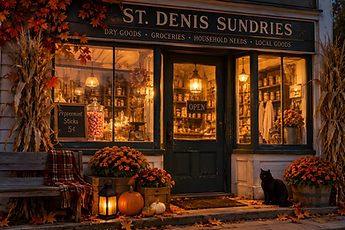
A Halloween Tale from St. Denis Sundries
One of the first things grandmother told me when I took over running St. Denis Sundries was never to lock the front door before six o'clock on Halloween.
"Some folks still have visiting to do," she'd say, with a knowing smile. "And it wouldn't be right to turn them away."
Grandmother believed that on All Hallows' Eve, when the veil between the living and the dead grew thin, it was only good manners to leave a light burning and a door unlocked. The dearly departed might have a mind to visit, and it wouldn't do to turn away an old friend.
I'd grown up hearing her say such things. Other people might dismiss them as old superstitions, but I'd spent too many afternoons at her kitchen table, listening to her talk about the old village, to disregard them entirely.
Our shop had stood near the end of Sutton Avenue for almost two centuries. My great-grandfather bought it from old Mr. Sandman, back when St. Denis was a proper little village with a fire hall, a bakery, and a band that played on summer evenings.
By the time grandmother turned St. Denis Sundries over to me, most of the village had disappeared. But the old country store remained.
I remember the things she taught me at that kitchen table. And so, every Halloween, I leave a lamp lit beside the front door of the shop.
On this particular October evening, I was setting up the last of the spooky decorations when the bell above the front door gave a little jingle. I looked over my shoulder, expecting a niece or nephew sent to remind me to come home for dinner.
Instead, an elderly gentleman stood just inside.
He wore a dark wool coat and carried a worn Homburg hat in his hands. His boots were muddy, and a faint mist seemed to cling to his shoulders.
"Evenin', miss," he said pleasantly. "Is old Sandman about?"
I explained that Mr. Sandman had been gone a very long time.
"Well, that's a shame," he said, shaking his head. "Fine fellow. Always kept a good store."
He glanced around appreciatively, and nodded with a faint smile.
"Changed things a bit, haven't you?"
"A little," I admitted. My great-grandparents bought the old shop from Mr. Sandman more than a hundred years ago.
He chuckled.
"I've come for my usual. Penny's worth of peppermint sticks, if you please."
As if I had just heard an old password, I reached beneath the counter for the glass jar and shopping paper Grandmother always kept there. Every October, I filled it with peppermint sticks, just as she had done.
While I wrapped his candy in a little square of paper, he leaned against the counter and began to talk. I listened.
He spoke of the old fire hall, where the band practiced on Thursday evenings. Of the steam engines pulling train cars that rattled past the village and of summer picnics down by the river. He mentioned neighbors whose names I'd seen written in Grandmother's old account books and on the two war memorials by the old elementary school.
Then his voice dropped.
"Strangest thing happened down by the river last evening," he said. "Saw a young woman standing near the water, dressed all in white. Looked like one of the nurses from up at the asylum."
He shook his head. My eyes grew wide; the old mental health asylum up the hill had closed in the 1950s.
"I called out, but she didn't answer. Just stood there, looking across the water. Then the fog rolled in, thick as chimney smoke. When it cleared, she was gone."
He leaned closer.
"Now, I don't put much stock in ghost stories, miss. But I know what I saw."
I nodded in reply and my eyes drifted toward the shop window. Beyond the glass, the October darkness blanketed the street.
Grandmother had once told me about a young nurse who'd been found nearby in the Patapsco River many years ago. She'd shown me the account in an old newspaper clipping, tucked between the pages of her Bible. She had kept the young woman in her prayers for many years.
"Perhaps she was looking for someone," I said slowly.
"Could be," he agreed. "But I reckon some folks have a harder time finding their way home than others."
The old man sighed heavily and straightened his coat. He reached for his candy.
"Well, I'd best be off. The wife's expecting me, and she'll have supper waiting."
He placed a penny on the counter and picked up his little package of peppermint sticks. The shop was suddenly very cold.
"Tell old Sandman I stopped by, will you?"
Before I could answer, the bell above the door gave another little jingle.
The gentleman was gone.
I hurried to the window, but Sutton Avenue was empty. No footsteps sounded on the pavement. No figure disappeared into the darkness.
Only a thin ribbon of mist drifted beneath the streetlight.
I went back to the counter to grab my jacket and the door key. The penny remained there, by the antique cash register we kept for show.
The penny was from 1895.
I stood there for a long moment, turning the ancient coin over in my hands, thinking about the gentleman's wife waiting for supper, the band playing in the fire hall, and the young nurse standing beside the river.
Perhaps somewhere, on some October evening, the old village still bustled with life. The trains still rattled along the tracks, the bakery windows glowed, and neighbors stopped at Sandman's store for a bit of gossip and a penny's worth of candy.
Perhaps the old gentleman had simply stepped out of that St. Denis and into mine.
I turned out the lights, leaving only the little lamp in the window beside the front door.
Grandmother had always said it was good manners to leave a light burning for those who hadn't yet found their way home. And I wasn't about to argue with her.
After all, this shop had been serving the people of St. Denis for generations.
There was no reason to stop now.


Comments